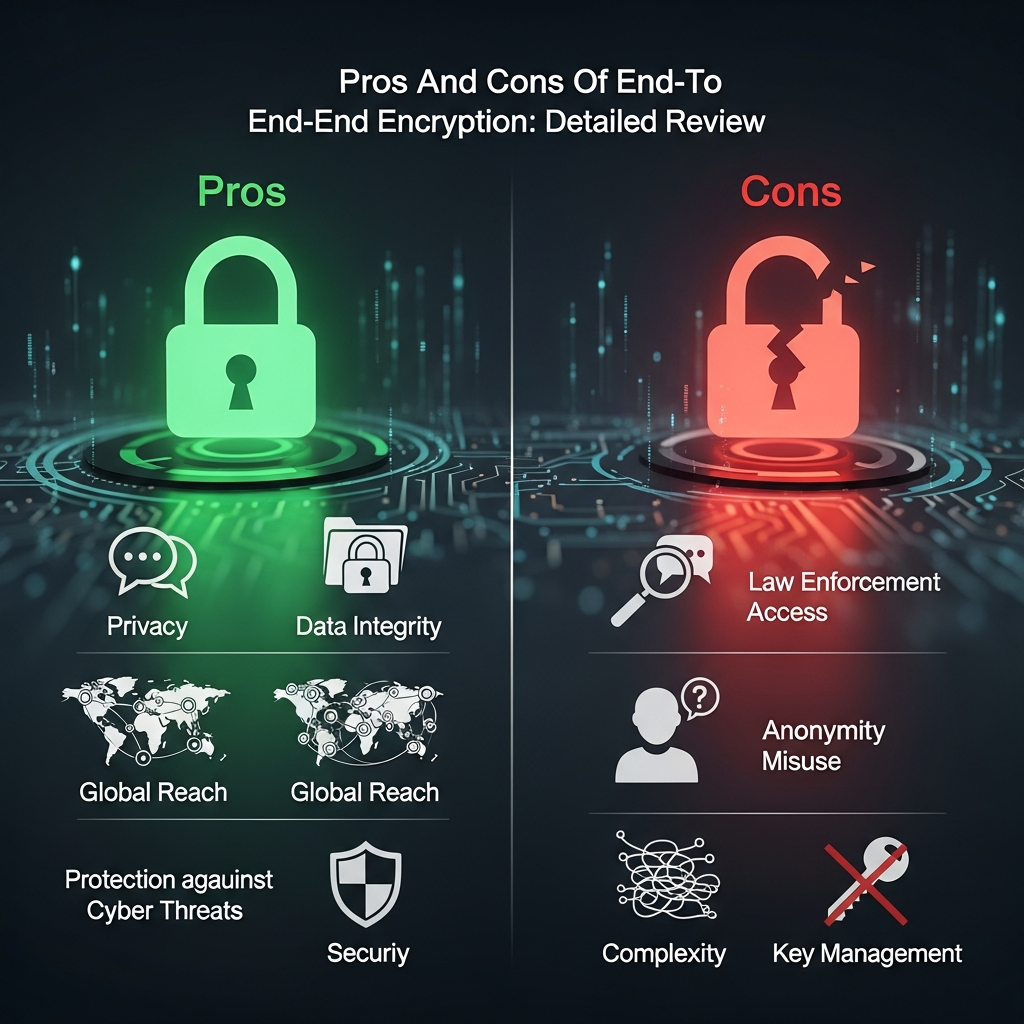
Pros and Cons of End-to-End Encryption: A Detailed 2024 Review
In an era where digital footprints are permanent and data breaches are a daily occurrence, the term End-to-End Encryption (E2EE) has moved from technical jargon to a household necessity. Whether you are sending a private message on WhatsApp, sharing sensitive documents via ProtonDrive, or conducting a confidential business meeting over Zoom, E2EE is the invisible shield protecting your information.
However, like any powerful technology, E2EE is a double-edged sword. While it offers unprecedented privacy for law-abiding citizens, it also presents significant challenges for cybersecurity monitoring and law enforcement. This detailed review explores the pros and cons of end-to-end encryption to help you understand its vital role in the modern digital landscape.
What is End-to-End Encryption (E2EE)?
Before diving into the advantages and disadvantages, it is crucial to understand what E2EE actually is. At its core, E2EE is a system of communication where only the communicating users can read the messages. No one else—not even the service provider, the internet service provider (ISP), or a government agency—can access the cryptographic keys needed to decrypt the data.
In a standard encrypted environment (Encryption in Transit), data is encrypted from your device to the server, decrypted by the server for processing, and then re-encrypted to the recipient. With E2EE, the data stays encrypted throughout the entire journey. It is only “unlocked” once it reaches the intended recipient’s device.
The Pros of End-to-End Encryption
1. Unmatched Data Privacy
The primary benefit of E2EE is the absolute privacy it affords. In a world where data is often harvested for advertising or surveillance, E2EE ensures that your private conversations remain just that—private. Because the service provider does not hold the decryption keys, they cannot peek into your messages even if they wanted to.
2. Protection Against Man-in-the-Middle (MitM) Attacks
Cybercriminals often use Man-in-the-Middle attacks to intercept data as it travels across the internet. Without E2EE, a hacker who successfully infiltrates a Wi-Fi network or a server could potentially read your data. With E2EE, even if a hacker intercepts the data packet, they will only see a jumbled mess of characters that are impossible to decipher without the private key stored on your device.
3. Security Against Server Breaches
We frequently hear about massive data breaches where millions of user records are stolen from corporate servers. If a service provider using E2EE is hacked, the attackers will find nothing but encrypted blobs of data. Since the service provider doesn’t store the keys, the hackers cannot unlock the stolen information, rendering the breach largely harmless for your actual message content.
4. Safeguarding Sensitive Business Information
For businesses, E2EE is a cornerstone of corporate espionage protection. Intellectual property, financial records, and strategic plans are high-value targets. Utilizing E2EE for internal communications ensures that sensitive data remains secure, even if the communication platform itself is compromised or subpoenaed.
5. Integrity of Data
E2EE protocols often include mechanisms to verify data integrity. This means that the recipient can be certain the message was not altered during transit. If a single bit of the encrypted data is changed by a malicious actor, the decryption process will fail, alerting the user that the message is no longer authentic.
The Cons of End-to-End Encryption
1. The “Going Dark” Problem for Law Enforcement
Perhaps the most controversial aspect of E2EE is its impact on criminal investigations. Because authorities cannot access encrypted communications, even with a warrant, it becomes difficult to track organized crime, terrorism, or child exploitation. This has led to a global debate regarding “backdoors” in encryption—a move that many security experts argue would weaken security for everyone.
2. Metadata is Still Visible
A common misconception is that E2EE hides everything. While the content of your message is hidden, the metadata often is not. Metadata includes information such as who you messaged, at what time, how often, and your IP address. This information can still be used to build a profile of your activities and associations.
3. No Data Recovery Options
The “end-to-end” nature of the encryption means that you are the sole gatekeeper of your data. If you lose your device or forget your recovery passphrase (and the service doesn’t have a secure backup mechanism), your data is gone forever. The service provider cannot “reset your password” to give you back your messages because they never had the key to begin with.
4. Complexity and Computational Overhead
Implementing E2EE is technically demanding. It requires more processing power on the user’s device to encrypt and decrypt data constantly. While modern smartphones handle this easily, it can still lead to slight delays in message delivery or increased battery consumption compared to non-encrypted alternatives.
5. Vulnerability of Endpoints
E2EE protects data in transit, but it does not protect the endpoints. If your physical device is stolen and you don’t have a strong passcode, or if your phone is infected with malware (like a keylogger), the encryption becomes irrelevant. The attacker can simply read the messages as they appear on your screen after they have been decrypted.
E2EE vs. Standard Encryption: Key Differences
To better understand the value proposition, let’s compare E2EE with standard transport layer security (TLS):
- Standard Encryption (TLS/SSL): Data is safe from your computer to the server. The server owner (e.g., Google, Facebook) can see your data.
- End-to-End Encryption (E2EE): Data is safe from your computer, through the server, all the way to the recipient. No one in the middle, including the server owner, can see it.
For most users, standard encryption is sufficient for non-sensitive tasks, but for any communication involving personal, financial, or legal matters, E2EE is the gold standard.
Popular E2EE Tools You Should Know
If you are looking to enhance your digital security, consider these widely recognized E2EE platforms:
- Signal: Widely considered the most secure messaging app, Signal is open-source and uses the highly-vetted Signal Protocol.
- WhatsApp: While owned by Meta, it uses the Signal Protocol for message encryption, though it collects more metadata than Signal.
- ProtonMail: An email service that offers E2EE between Proton users and PGP support for others.
- Bitwarden: A password manager that uses E2EE to ensure only you can access your vault.
The Future of Encryption: Post-Quantum Concerns
As we look toward the future, the rise of quantum computing poses a theoretical threat to current E2EE standards. Most modern encryption relies on mathematical problems that are difficult for traditional computers to solve but could be trivial for a quantum computer. Researchers are currently developing “Post-Quantum Cryptography” to ensure that E2EE remains viable for decades to come.
Final Verdict: Is E2EE Worth It?
In the debate over the pros and cons of end-to-end encryption, the “pros” overwhelmingly win for the average user. The protection of fundamental human rights, such as privacy and freedom of expression, depends on the ability to communicate without fear of eavesdropping.
While the challenges for law enforcement are real, compromising encryption to catch criminals would create a “backdoor” that hackers and authoritarian regimes would inevitably exploit. For the layperson, the slight inconvenience of managing recovery keys is a small price to pay for the peace of mind that your private life remains private.
Summary Table: Pros vs. Cons
| Feature | Pros (Advantages) | Cons (Disadvantages) |
|---|---|---|
| Privacy | Total content secrecy. | Metadata is often still exposed. |
| Security | Protection against server hacks. | Endpoints (devices) remain vulnerable. |
| Access | Only you have the keys. | No way to recover data if keys are lost. |
| Society | Protects whistleblowers/journalists. | Can be misused for illicit activities. |
Frequently Asked Questions (FAQ)
Can E2EE be hacked?
Technically, the encryption itself is almost impossible to “crack” with current technology. However, a user can be “hacked” through phishing, malware on their device, or if they lose physical control of their phone. The encryption protects the journey, not the destination.
Does E2EE slow down my internet?
In most cases, the impact is negligible. Modern processors are optimized for encryption. You might notice a very slight delay in sending large files, but for text messages and voice calls, you won’t feel a difference.
Why do governments want to ban E2EE?
Governments argue that E2EE creates a “safe haven” for criminals, making it impossible to intercept evidence of crimes. They often advocate for “responsible encryption” or “backdoors,” which privacy advocates argue would fundamentally break the security of the internet.
Is Telegram end-to-end encrypted?
By default, Telegram uses “Cloud Chats” which are encrypted but not E2EE. To use E2EE on Telegram, you must manually start a “Secret Chat.” This is a key difference between Telegram and apps like Signal or WhatsApp.
Can hackers see my metadata?
Yes, in many implementations, metadata (like who you are talking to) is visible to the service provider and potentially to hackers who intercept your traffic. Some advanced tools like Tor or certain privacy-focused messengers work to hide metadata as well.
Conclusion: Understanding the pros and cons of end-to-end encryption allows you to make informed decisions about your digital hygiene. In an age of surveillance, E2EE is your best defense for maintaining your digital autonomy.