What Is a Marketing Funnel? A Comprehensive Guide to Mastering the Customer Journey
In the rapidly evolving landscape of digital commerce, understanding how a stranger becomes a loyal customer is the cornerstone of any successful business strategy. You may have heard the term “Marketing Funnel” mentioned in boardrooms or read about it in marketing blogs, but what does it actually entail?
At its core, a marketing funnel is a conceptual framework that illustrates the theoretical journey a consumer takes towards purchasing a product or service. It is a visualization of the process of turning leads into customers, and eventually, brand advocates.
This guide is designed to provide you with a deep, comprehensive understanding of the marketing funnel. Whether you are a business owner, a marketing student, or a professional looking to sharpen your skills, this article will walk you through every stage, strategy, and metric you need to know.
The Fundamental Concept: Why “Funnel”?
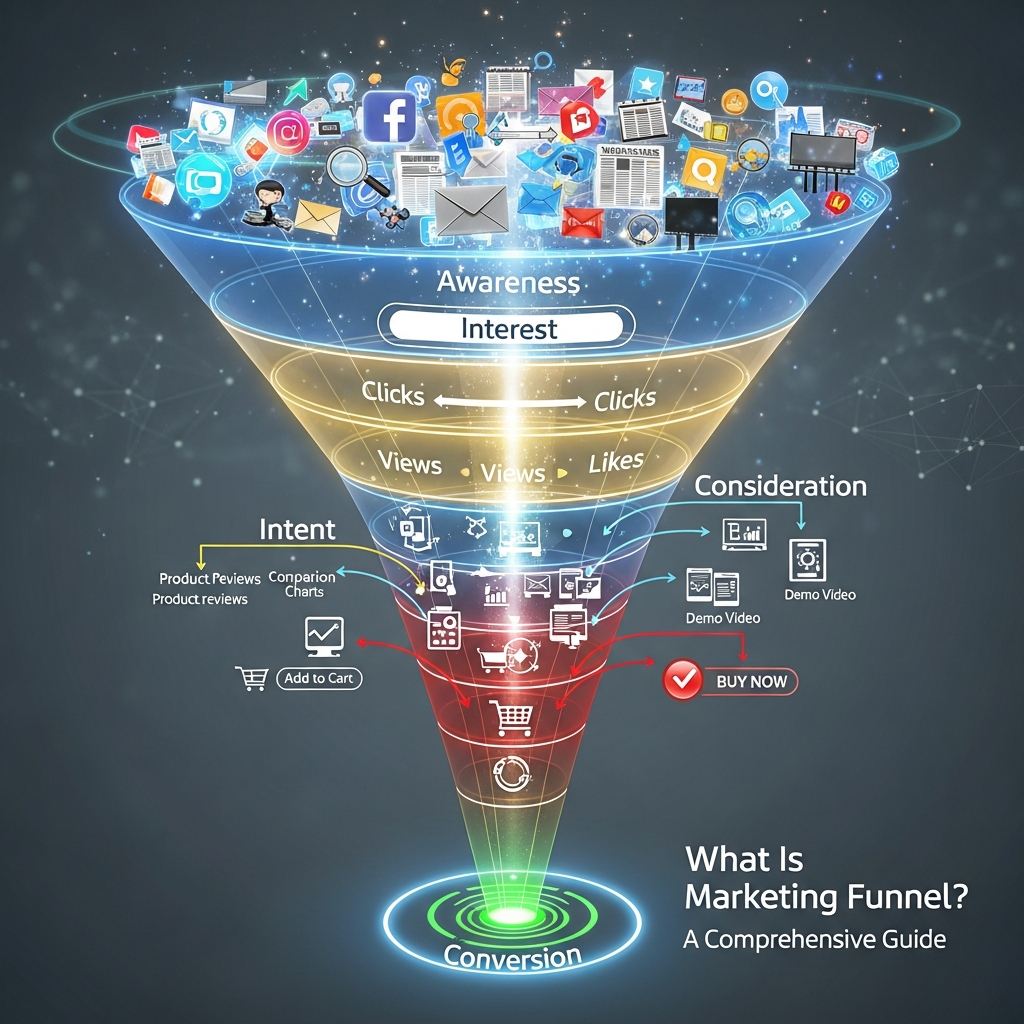
The term “funnel” is used because of its shape. At the top, you have a wide opening where a large number of people might become aware of your brand. As they move through the various stages of the decision-making process, some drop off, and the group narrows.
By the time you reach the bottom of the funnel, you are left with a smaller, highly qualified group of individuals who are ready to complete a transaction. Your goal as a marketer is to make this funnel as efficient as possible, minimizing “leaks” where potential customers might lose interest and exit the process.
Why Your Business Needs a Well-Defined Marketing Funnel
Operating without a defined funnel is like driving in a foreign city without a GPS. You might eventually reach your destination, but you will likely waste significant time and fuel. Here is why a marketing funnel is essential:
- Consistency in Lead Generation: It provides a repeatable system for attracting new prospects.
- Improved Conversion Rates: By providing the right information at the right time, you increase the likelihood of a sale.
- Better Budget Allocation: You can identify which stages are underperforming and invest your resources where they provide the most Return on Investment (ROI).
- Predictable Revenue: A mature funnel allows you to forecast sales based on the number of leads entering the top.
- Enhanced Customer Experience: You treat customers based on their specific needs and readiness to buy, rather than using a “one-size-fits-all” approach.
The Three Main Pillars: TOFU, MOFU, and BOFU
To manage a funnel effectively, marketers typically divide it into three primary sections. Each section requires different content types, communication styles, and marketing tactics.
1. Top of the Funnel (TOFU): The Awareness Stage
The Top of the Funnel (TOFU) is the widest part of the journey. At this stage, your target audience is experiencing a problem or a need, but they might not even know your brand exists. Your primary objective here is Awareness.
You are not trying to sell a product at this stage. Instead, you are providing value, answering questions, and establishing your brand as a helpful resource.
Key TOFU Strategies:
- Content Marketing: Educational blog posts, “how-to” guides, and infographics that solve common pain points.
- Social Media Marketing: Engaging posts on platforms like LinkedIn, Instagram, or TikTok to reach new demographics.
- Search Engine Optimization (SEO): Optimizing your website for keywords that your potential customers are searching for.
- Video Marketing: Short, informative videos that introduce concepts related to your industry.
2. Middle of the Funnel (MOFU): The Consideration Stage
Once a prospect recognizes their problem and knows your brand can help, they enter the Middle of the Funnel (MOFU). This is the Consideration and Evaluation stage.
The prospect is now evaluating different solutions. They are comparing your offerings against competitors. Your goal is to build trust and demonstrate why your specific solution is the best fit for their needs.
Key MOFU Strategies:
- Lead Magnets: Offering high-value content like E-books, whitepapers, or templates in exchange for an email address.
- Email Marketing: Nurturing leads with personalized sequences that provide deeper insights into your product’s benefits.
- Webinars: Interactive sessions where you can demonstrate expertise and answer specific audience questions.
- Case Studies: Real-world examples of how you have helped other clients achieve success.
3. Bottom of the Funnel (BOFU): The Decision Stage
The Bottom of the Funnel (BOFU) is where the “magic” happens. The prospect is ready to buy but needs one final nudge to choose you over everyone else. This is the Conversion stage.
Your messaging should be very specific, direct, and focused on removing any final friction or doubts.
Key BOFU Strategies:
- Free Trials and Demos: Letting the customer experience the product firsthand.
- Product Comparisons: Direct comparisons that highlight your unique selling points (USPs).
- Testimonials and Reviews: Social proof from satisfied customers to build final confidence.
- Discount Codes or Limited-Time Offers: Incentives that create a sense of urgency.
The Modern Evolution: Retention and Advocacy
The traditional marketing funnel often ended at the “Purchase” stage. However, modern experts recognize that the journey continues. Keeping a customer is significantly cheaper than acquiring a new one. Therefore, the funnel has evolved to include:
- Retention: Engaging with the customer after the sale to ensure they are getting value from the product. This includes onboarding emails and excellent customer support.
- Advocacy: Turning satisfied customers into brand ambassadors who refer others to your business. This creates a “loop” or “flywheel” effect, feeding the Top of the Funnel with high-quality referrals.
Step-by-Step Guide: How to Build Your Own Marketing Funnel
Building a funnel from scratch can feel overwhelming. Follow these steps to create a structured path for your prospects:
Step 1: Define Your Target Audience (Buyer Personas)
You cannot build a path if you don’t know who is walking on it. Create detailed Buyer Personas. What are their pain points? Where do they hang out online? What motivates their buying decisions?
Step 2: Map the Customer Journey
Identify the specific touchpoints your audience uses. Do they find you through Google search? Do they read reviews on Third-Party sites? Mapping this helps you place the right content in the right places.
Step 3: Choose Your Channels
Select the platforms that align with your audience. If you are a B2B company, LinkedIn and Email might be your primary channels. If you are a B2C fashion brand, Instagram and Pinterest might be more effective.
Step 4: Create Content for Every Stage
Develop a content calendar. Ensure you have a mix of educational (TOFU), persuasive (MOFU), and transactional (BOFU) content. Use Call-to-Actions (CTAs) to guide the user from one piece of content to the next.
Step 5: Implement Lead Capture and Nurturing
You need a way to keep in touch with prospects. Use landing pages with forms to capture leads. Then, use Marketing Automation tools to send automated follow-up emails based on user behavior.
Step 6: Analyze and Optimize
A marketing funnel is never truly “finished.” Use analytics tools to see where people are dropping off. If many people visit your blog (TOFU) but don’t sign up for your newsletter (MOFU), your lead magnet might need improvement.
Crucial Metrics to Track Your Funnel’s Health
To know if your funnel is working, you must track the right Key Performance Indicators (KPIs).
- Traffic: The number of unique visitors entering the Top of the Funnel.
- Conversion Rate: The percentage of users who move from one stage to the next.
- Cost Per Acquisition (CPA): How much you spend to gain one new customer.
- Customer Lifetime Value (CLV): The total revenue a customer generates during their entire relationship with your brand.
- Churn Rate: The percentage of customers who stop using your service over a specific period.
Common Marketing Funnel Mistakes to Avoid
Even experienced marketers make mistakes. Be mindful of these common pitfalls:
- Ignoring the “Leaky Funnel”: Focusing only on getting more traffic while ignoring the fact that your website doesn’t convert is a waste of money.
- Being Too “Salesy” Too Early: Trying to close a deal in the TOFU stage will often scare prospects away. Build trust first.
- Lack of Alignment Between Marketing and Sales: The marketing team and sales team must agree on what constitutes a “qualified lead” to ensure a smooth handoff.
- Neglecting Existing Customers: Don’t forget the people who have already paid you. A small investment in retention can lead to massive long-term growth.
The Role of Technology in Modern Funnels
Today, you don’t have to manage every lead manually. Marketing Automation software (like HubSpot, Mailchimp, or Salesforce) allows you to:
- Segment your audience based on behavior.
- Send personalized messages at scale.
- Track the exact path a user took before buying.
- Score leads based on their engagement levels.
Conclusion
The marketing funnel is not just a theoretical model; it is a practical blueprint for business growth. By understanding the nuances of Awareness, Consideration, and Decision, you can create a seamless experience that guides potential customers toward choosing your brand.
Remember that the best funnels are built on a foundation of empathy. When you focus on solving your customers’ problems and providing genuine value at every stage, the sales will naturally follow. Start by auditing your current process, identifying the gaps, and building a journey that you would want to take as a customer yourself.
Frequently Asked Questions (FAQ)
What is the difference between a Marketing Funnel and a Sales Funnel?
While often used interchangeably, the marketing funnel focuses on the entire journey from awareness to interest. The sales funnel typically starts when a lead is qualified and handed over to the sales team to close the deal.
How long does it take for a marketing funnel to work?
It varies by industry. For low-cost consumer goods, a funnel might take a few days. For high-ticket B2B services, the journey through the funnel can take several months.
Do I need a large budget to create a marketing funnel?
No. You can start small with organic SEO, social media, and basic email marketing. As you generate revenue, you can reinvest in paid advertising and sophisticated automation tools.
What is a ‘Leaky Funnel’?
A leaky funnel refers to a situation where potential customers drop out of the journey at an unusually high rate due to poor user experience, lack of follow-up, or irrelevant content.